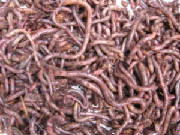
Worms are an excellent insect control method for farmers. Worms offer not only agreat
fly control solution; but also 1 pound of worms can turn ½ pound of waste into useful fertilizer, (65 pounds of worm
castings in 100 days). It can also be a very lucrative "home business" with minimal work and start up expenses.
It is an easy business to expand as well.
Housing your worms
can be done in many ways. You can raise worms in ground beds or raised beds; we use both methods. Raised worm boxes
can be built of wood, fiberglass, plastic or metal. Concrete blocks also work well for ground beds. Whatever material you
can easily and cheaply obtain can be made to work. The use of lights will help keep the worms "down". Composting
bins are also popular, ready made units are available or make your own using "non-breathing" materials such as plastic,
fiberglass or metal containers; they should be perforated with small holes for drainage, filled 1/3 with dampened bedding.
Pull back bedding, introduce the worms and then cover them with bedding about 2 inches deep, top with a cover or screen
to guard against flies. All beds should be kept from direct sunlight.
Boxes
built on the ground do carry more risk of "contamination" from other native breeds of worms, as well as predators.
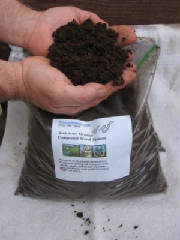
We use the ground beds under our rabbits to control insects and bag up the composted worm manure for sale and use in
our gardens. Some growers line their beds with hardware cloth or netting to prevent gophers or moles from eating the worms.
Use sideboards around the perimeter to contain the beds. Our ground beds are about 5' wide and 12" high. They line up
with the feeders on the outside of the rabbit cages hung above them. We raise most of our Red Wigglers and African Nightcrawlers
in the ground beds and use raised beds for the Eisenias to protect them from being taken over by larger and more aggressive
species we raise. Be sure to protect your beds from possums, raccoons, armadillos and other hungry critters.
One square foot of surface area can contain one pound of worms. 2' x 2 ‘
and 12 inches high will hold 4000 breeders, when harvested monthly. This works out to 1000 breeders per square foot. We work
mostly with a 4' x 8' boxes. They offer a comfortable reach for harvesting and maintenance. For composting bins, one 18 gallon
tub, (72 Quart) will support up to 1 pound of worms.
Nursery quality
peat is the recommended medium to begin beds. Be sure to soak in water for 24 hours to reach its maximum moisture
levels before introducing the worms. We have also used horse manure from barn stalls, it contains a nice mix of sawdust and
manure, (be careful that the horse has not been recently wormed and the manure is no longer "hot"). Shredded paper
can also be a cheap medium.
Regardless of the type of container
you use - stock the beds with the type of worm you and/or your BUYER WANTS. Not all worms are alike.
There are a number of different types of worms. Names often vary by region; worms commonly referred to as "Red Worms"
include the Eisenia foetida, the most popular choice for composting. Eudrillus eugeniae, (African Nightcrawlers) very prolific,
and Pheretima Hawayanus, (known as the "Hybrid Red Worm"), are popular bait worms. These are the hardier worm varieties;
and are more tolerant of shipping and handling, they are the worms that we sell.
To water your beds, mist heads are the recommended way to go. Usually hand watering
can be difficult to distribute water evenly. However, done CAREFULLY, it can work well. You need to maintain a balance of
70 - 80% moisture - 3:1 ratio. The "soil" should be wet enough to squeeze 1 drop of water out of a handful of "soil".
They are not fish! Using an automated timer can be a great way to regulate the water.
Worms need to be fed when the tops of your beds are covered with fine grains of "soil".
This tells you that the worms have "processed" their "food" and an additional amount of feed is required.
You can buy a "mashed type" worm feed. If you feed cornmeal, beware of high salt content and oily foods, it can
cause problems. We raise rabbits above most of our worm beds and use the droppings as worm "feed" which works very
well. You may harvest cow patties or use any other form of animal waste. BE CERTAIN that if you use animal manure that the
animal has NOT been wormed recently or you will KILL your worms. Horse manure and rabbit manure seem to be ideal. You may
also use cardboard or shredded newspaper for feed. Worm production can be boosted with additional protein feed. One pound
of worms will eat 1/2 pound of food every day. DO NOT OVER FEED food waste, kitchen scraps, old vegetables, coffee grounds,
egg shells, etc., you could be inviting trouble with ants as well as other critters enjoying a free bite and perhaps eat your
worms too! Overfeeding "worm feed" can result in moldy feed and endanger your worms. Be certain to cut up your kitchen
scraps into small pieces - they have small mouths! You should also bury kitchen scraps under a thin layer of bedding to prevent
mold and flies.
Should you have ants in your beds, dig
out the marauders or spot treat them with a granulated ant killer. Remember, ants are not elephants, use sparingly;
a little bit goes a long way. Do not over load your beds with chemicals, it will kill the worms. Granular Calcium Carbonate
or Dolomite can be used to maintain a favorable pH level of 5.6 to 7.0. Red Mites are another enemy of the worm. Prevention
is the best solution - a high mite population generally reflects over watering/poor drainage or over feeding. Less feed and/or
allowing the bed to dry out can resolve this problem.
Depending on the
type of worm you raise, a general rule of thumb is that the worms will mature in 90 days and begin laying
eggs. They produce an average of 3 - 4 eggs each month. The eggs hatch in 21 days and each capsule may contain 2 - 20 worms
each. They can triple their numbers every 90 -120 days. Allow 4 - 6 months for the worms to grow to the size most fish bait
consumers' desire. Be careful to allow your beds to reach a high level of productivity and egg lying BEFORE YOU BEGIN HARVESTING.
If you harvest too soon, you may unknowingly wipe out your adult breeders and therefore, future production. Harvest regularly,
every 30 days, when conditions are right, worms will reproduce quickly. Your worms need to be turned over to stay "healthy".
GENTLY use a pitchfork, not a shovel, A worm cut in half does not = two worms; it equals 2 dead half pieces of a worm. Always
replenish the harvested bed with fresh bedding to assure continued production.
Worms
will "leave "a bed that is not maintained to their liking. They will "go down"
during cooler temperatures in the winter and come up as it warms; but will run off if a bed is too hot, dry or wet. It is
best to raise worms in a cool area - under shade trees, a covered barn, etc. Some growers use fans, misters or air conditioning
units in a storage area to assure the temperature does not get too high. Constant lighting is recommended to keep the worms
from "running". Never refrigerate the types of worms we have mentioned! 50 - 70 degrees is the average temperature
to maintain for your worms.
We recommended that new growers enter the
business on a smaller scale. We can provide you with a good starting amount depending on
your goals. You should get the hang of raising worms successfully before increasing production. Be certain to buy your foundation
stock from an established grower and have your market connections firmed up early.
If you have any questions
please do not hesitate to contact us either by phone or e-mail.
Mike & Dee info@bestbuyworms.com or call 352.796.0459 Monday - Saturday 9:00 a.m. - 7:00 p.m.
JUST FOR KIDS!
Enjoy
a wonderful series of books for children that introduces children to backyard composting through the adventures of Pee Wee,
the endearing little red wiggler worm, and all the insects in the compost heap. The adventure begins when four neighbourhood
children are magically transported on the back of a butterfly to visit Castle Compost.